Author:
Funmito Obafemi
Author:
Funmito Obafemi
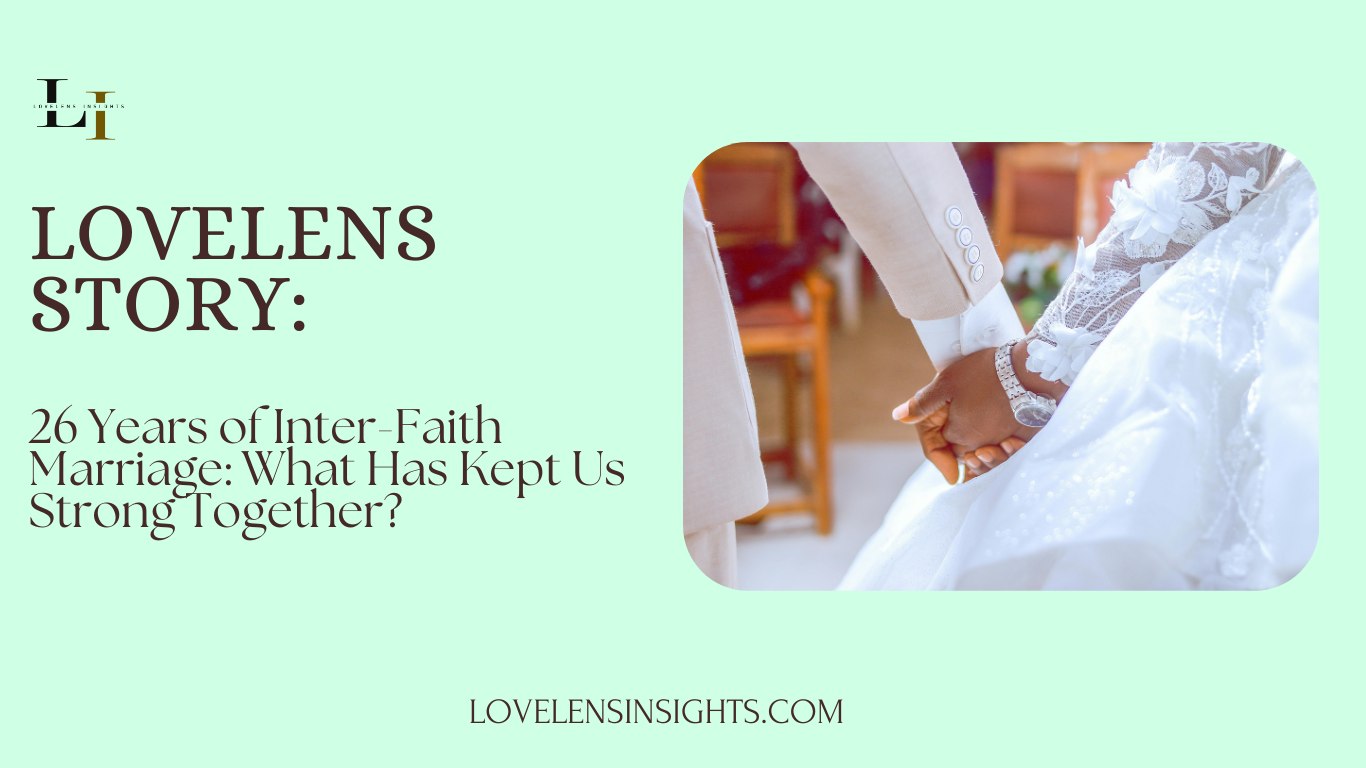
In this interview, I sat down with my parents, who have been married for over 26 years. My father, Ade, who is a Muslim, and my mum, Kemi, who is a Christian. Together, they’ve practiced interfaith marriage and built a home filled with love, faith, culture, and humour. I wanted to hear the real story behind their journey, challenges, and what has kept them going for more than two decades.
Ade: How we met was quite powerful. When I was a bachelor, I had already decided that I would never date two women at the same time. I met my wife through my younger sister, who both attended the same secretarial school in 1993.
One day, my younger sister visited me, and she did something. Then, I told her, “What’s making you happy? Your brother is this old and isn’t married yet, and you, as a woman, can’t do anything about it.” The words touched her, and she left. The next time she visited, she came with your mum, and that’s how we met.
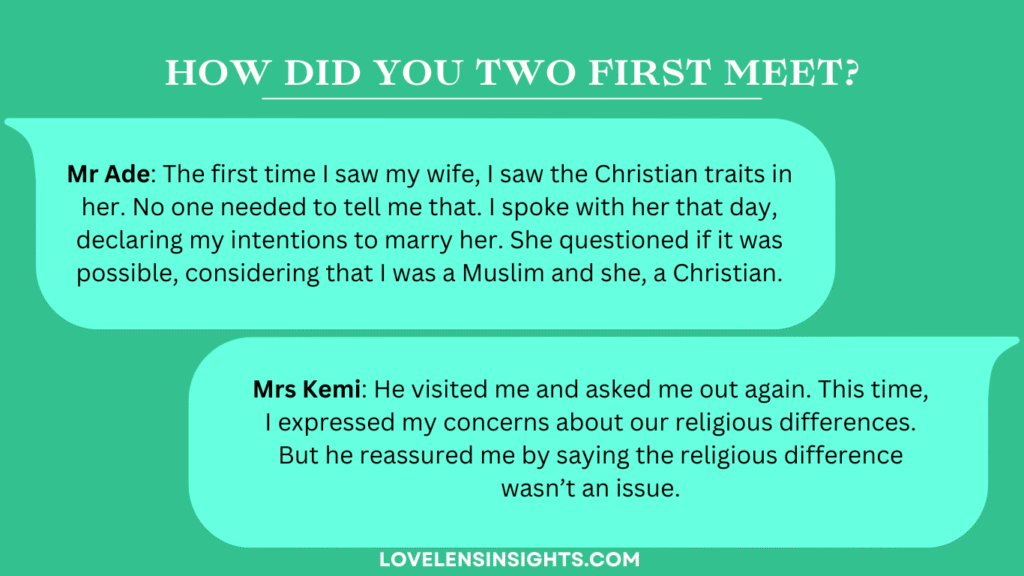
The first time I saw your mum, I saw the Christian traits in her. No one needed to tell me that. Then, my sister introduced my wife to me. I spoke with her that day, declaring my intentions to marry her.
She questioned if it was possible, considering that I was a Muslim and she, a Christian. I responded by saying the religious differences weren’t an issue.
Kemi: I attended the same school — Goodnews Secretariat School — with his sister in 1992/93. We would always meet in the afternoon and were very close. She would also visit me at my house. One day, while I was at home, she stopped by her brother — they only came to say, “Hello.”
Two or three weeks later, she came over to visit me. Then, she mentioned that someone (her brother) wanted to see me. We did visit him together, and that was when he asked me out. I told him I needed time to think about it, and he should pray about it.
Some days later, I travelled to Lagos to buy goods, and upon my return, he visited as usual. I wasn’t around when he arrived, so my mum entertained him with snacks and drinks while he waited for me.
Upon my return, we talked, and he asked me out again. This time, I expressed my concerns about our religious differences. But he reassured me by saying the religious difference wasn’t an issue. We courted for 7 years, and I took my time observing his character.
Ade: I told her from the start that I was interested in her. I was also serious and prayed concerning the relationship. But prayer wasn’t the sole focus. I was a man of actions and showed it. I saw her as wife material, wanted, and focused on getting her.
Kemi: I saw that he had a good character. He was sincere. If he said he was going somewhere, you’d meet him there. There were times I would go supply goods and visit him unannounced, and I wouldn’t meet anyone else in his house. Besides, he was a very focused man.
There were two exams (ATS 1 and ATS 2, organized by ICAN) that he wanted to take to advance his position in the civil service commission. He passed those exams. Since I saw those serious traits in him, I was encouraged to say yes to him.
Ade: The first day I met her was when I knew I would commit to her. Before I met my wife, I was dating someone else who was a Muslim. However, her character wasn’t pleasing to me, and I figured out it wouldn’t favour me in the future.
But right from the first day I saw my wife, I knew in my heart, even though she was a Christian. I could sense she was good wife material and was objective about the situation.
Besides, she exhibited some traits, which is good, as the woman loves the man in return. Not just the man. If the love is one-sided, such a union may not last. An example was when I had financial difficulties while I was trying to move forward in life.
I came from a poor background where no one could assist me financially. I worked hard to finish secondary school, pass the exam, earn the certificate, and used it to get a job at the state civil service. But I earned a low income in the statistics department where I was first positioned.
One day, I was sent on an errand by my boss to give a letter to another boss in another department, the state’s revenue agency. When I dropped the letter, this other boss offered to pay my transport fare in return. When he opened the drawer, it was full of money. He gave me N200 (ten N20 notes, the highest denomination at that time) as transport fare.
As I was going back to the office that day, I made up my mind to transfer to that department. To do that, I would have to sit for two professional accounting exams (ATS 1 and 2) organized by ICAN.
I inquired about the cost of studying those courses and was told it would cost N4,000. However, I didn’t have the money. When I told my wife about the exams, she gave me N2,000 out of the N4,000.
Also, when I was ill, and there was no family member to pay for my treatment, she gave me the money for surgery. The cost was N4,000, and my wife gave me another N2,000 for the surgery.
Those acts of kindness made me realize that only someone who loves you can express them. After all, I’m the kind of person who doesn’t forget how I’m treated, whether good or bad. I appreciate people when they do good to me, and don’t forget when they maltreat me. Overall, the first day I met her was when I knew I wanted to marry her.
Related story: I converted to Christianity before I married my wife
Mr Ade: I’ve always been a one-man soldier. No family member pushed me to get married. I made most of my life’s decisions on my own — even though I had parents. One person who could have helped my life was my dad, but he passed away early.
My mum played a little role in raising us. From a young age, I learned to fend for myself — financially and academically. So, when it came to marriage, I chose both the timing and person entirely on my own.
Kemi: The differences didn’t scare me because I was born and raised a Muslim. However, I never felt connected to the religion due to the style of prayer. When I later moved to my uncle’s home — where Christianity was practiced – I embraced the Christian faith.
Ade: Before I make any decision in life, I always weigh the pros and cons. Before marrying her, I assessed her Christian lifestyle. I had seen some interfaith marriages that didn’t work out, so I needed to be sure. But the truth is, it all depends on how you view religion.
First, I see both religions as foreign concepts introduced by the Europeans and the Arabs. After all, our traditional religion is our original root. So when I view religion from that perspective, I don’t have any issue with it and don’t see it as something that should divide us.
That’s why even my children are all Christians. If I wanted them to become Muslims, I would have done that from the beginning, inviting the Quranic teachers to guide them in the Islamic way of life, but I didn’t.
Likewise, I don’t stop her from fully participating in any church activities. Also, the level of interest matters. If she were a strict Muslim, and I, the flexible spouse, she probably wouldn’t let me practice Christianity, and our marriage may have collapsed.
Besides, with the nature of my work, I was constantly posted from one location to another. If I had insisted that my children practice Islam, it may not have worked out the way I wanted. In the end, the children may grow up confused and end up not practicing any religion.
That’s why younger people should be careful. If you marry a woman of a different faith and you force her to practice your religion upon marrying her, your children may not end up practicing any religion.
That’s because you, as the father, would have to work and may not have the time to raise your children in that religion. But if the woman spends more time with them, then let her raise them in her faith.
Related story: A random day at work became the beginning of our union
Kemi: There were challenges, but God helped us to overcome. For instance, his younger siblings became envious of me at one point. They saw that I was ambitious, and my business was doing well financially. They assumed I was proud and wanted me to move out of my husband’s house.
When we built our house and invited them to the housewarming, they were annoyed that we hadn’t kept them informed about the process. But the truth is, I’m a private person who doesn’t share my plans with people as they unfold.
Ade: I sensed jealousy and hatred during that time, but I handled it in two ways. First, they weren’t the ones married to her. Next, I was independent. Since I grew up fending for myself and taking on some of their responsibilities, I had the upper hand in resolving the issue.
I made it clear she was my wife and was going nowhere. It’s either that they love and accept her as I do, or leave us alone. Everyone can live by themselves. This was a serious matter that resulted in a family meeting.
Even when an older family member lived with us for a while and was teaming up with those against her, I stood my ground and made it clear that my wife wasn’t leaving. It’s either she loves my wife or she leaves us.
Kemi: Before we married, he promised he wouldn’t interfere with how I practiced my religion. That promise exists to date. It doesn’t matter if I want to visit the church today or attend Bible study tomorrow; I can go and return home. I also practice my duties in the house.
For instance, when it’s time for Ramadan, I wake up early to make his meal. If I want to go to a prayer meeting for 2 days, I’ve got the freedom to do so. I thank God for the grace that extends to the children as well.
Also, he’s calm. When we offend each other, we settle it amicably. No external party has interfered in resolving our internal affairs.
Ade: She’s very hardworking and loyal. That’s love to me. Also, the way she does her business is what I love. She has my full support on that. She nags too, but dislikes laziness.
Ade: The first thing is interest. If you want to marry anyone, you’ve got to love them. How do you know? Look at their characters. For instance, when my siblings wanted her out of my marriage, I showed love by letting them know that it’s either they accept her or leave us alone. That’s love. It’s not every man who can do that because he wouldn’t want to offend his wife and his extended family.
Since he doesn’t want to offend the external members, it would give them the chance to intrude and scatter his home. A man should stand on his feet and make his intentions known even when it doesn’t please them.
This doesn’t mean he shouldn’t like them. His love for his siblings shouldn’t influence his marriage. Today, everyone lives by themselves, which is how it should be.
Next, study the person very well. Don’t attempt to manage the person’s character when you see unfavourable signs during courtship. When someone loves you, they won’t hurt you. Instead, they’d be kind, pamper, and care for you. Study their characters well.
Also, make sure your partner is employable. Money is essential in any marriage. He must have good people to advise him. Also, look at his religious style. If you notice the person is strict about religion, make sure it aligns with you.
Kemi: The first thing is prayer. Fast and pray because marriage is a long journey. Also, love is the foundation of the union. Love your partner like the book of Corinthians advised. Love is kind, patient, not easily provoked, or disrespectful.
If you’re a couple and would love to share your story, fill out this form.